NAMUX Generations Explained
Posted by Kustom Truck Parts on 29th Dec 2025
PACCAR NAMUX Generations: Engine-to-Cab Interface Nuances for Peterbilt and Kenworth Engine Conversions
Drivers, owners, and operators—if you're knee-deep in Peterbilt or Kenworth builds and repowers, you've probably bumped into the term "NAMUX" more than once. It's the backbone of modern chassis electronics in PACCAR's lineup, and understanding its generations can make all the difference when sourcing parts, troubleshooting, or planning an engine conversion. At Kustom Truck Parts, we're all about making those HD swaps seamless, and this deep dive is your go-to reference for how PACCAR Chassis electronics shifted through the years to accommodate the engines that were available during initial production.
Success starts with understanding the engine-to-cab interface in PACCAR's NAMUX (North American Multiplexing) generations. From the mid-'90s transition to electronic engines onward, each generation changed firewall pinouts, J1939 introduction and data sharing, gauge/switch integration, and harness compatibility.
Correctly identifying your truck's NAMUX generation eliminates guesswork, clarifies what the Engine Harness connects to, and ensures reliable communication—no blank gauges, faulty switches, or persistent DTCs (Diagnostic Trouble Codes). Here's your detailed reference guide.
PreNAMUX: Engine-Specific Fully Hardwired (Pre-April 2005)
Pure analog era—no multiplexing or shared J1939 for cab functions. Every signal ran dedicated wires from ECM to specific dash functions.
A quick historical note: This was the last era where Peterbilt and Kenworth offered Detroit Diesel as a factory engine option—up through 2003 with pre-EGR DDEC IV electronics. Starting in 2004, the DDEC V Series 60 became proprietary to Freightliner and Western Star, narrowing factory choices to primarily Cummins and Caterpillar as the industry moved toward multiplexing.
Quick ID Tips:
- Old School Metal toggle switches (check jake brake and cruise control switches—they're toggles here)
- Factory engine options included Detroit (up to 2003), Cummins, and Caterpillar
Key Models:
- Peterbilt: 357, 377, 378, & 379
- Kenworth: T600, T800, & W900
Engine-to-Cab Interface Nuances:
- Firewall Canon plug pinout and dash harness completely engine-specific (e.g., CAT C15 6NZ vs. Cummins ISX CM570 vs. Detroit Series 60—firewall pinouts differ)
- Gauges driven by direct senders or hardwired ECM outputs; no J1939 cab integration
- Switches all analog/hardwired
Conversion Considerations: Identifying the model of truck AND the starting engine are critical components to a timely, seamless engine conversion. This ensures the swap takes place on the engine side of the firewall rather than behind the dash.
Real World Situation: Since the dash is wired for the engine in this generation, the Engine to Cab Harness for a 2001 Peterbilt 379 that started with a Detroit S60 DDEC4 being replaced by a CAT C15 6NZ is going to take a different Engine to CAB Harness for the same 6NZ to be installed in a 2001 Peterbilt 379 that started with a Cummins ISX with CM570 ECM electronics. Don't forget, you won't have throttle response until you replace the TPS on the side of the pedal with a compatible CAT Throttle Position Sensor.
NAMUX1: Smart Gauges, Analog Switches (2006–2007)
First multiplex step with an ICU (Instrument Cluster Unit) handling basic J1939 data communicaton for gauges only. Switches stayed analog—true multiplexing wasn't here yet.
Quick ID Tips:
- Plastic rocker switches (jake brake and cruise are rockers now)
- ICU module
Key Models:
- Peterbilt: 357, 378, 379, 384, & 386
- Kenworth: T600, T800, & W900
Engine-to-Cab Interface Nuances:
- Factory engines limited to Cummins (EGR-era ISX/ISM) or Caterpillar (ACERT twin-turbo tech)
- Firewall Canon plug still wired specifically for either CAT or Cummins—no universal standard yet
- Gauges "smart" via J1939 from ECM to ICU (tach, temps, etc., pull directly from data link—no dedicated senders)
- Switches remain analog/hardwired (no multiplexed messages)
Conversion Considerations: Engines with limited J1939 capabilities such as CAT 40-Pin ADEM2 or the Cummins Celect Platform require a data processor in addition to the harness to convert data between J1587 and J1939.
Real World Situation: The Engine to Cab Harness used in a 2005 Kenworth W9 with metal toggle switches replacing a Cummins with CAT engine is not the same Engine to Cab Harness a similar W9 with plastic rocker switches would use.
NAMUX2: Full Smart Dash with CECU (2008–2010)
Introduction of the CECU (Cab Electronic Control Unit)—now switches join gauges on the J1939 multiplex network for a truly digital dash. This widespread implementation of diesel particulate filters (DPFs) as standard equipment is now fully realized. This was also the last generation where Caterpillar engines were available as a factory option in Peterbilt and Kenworth trucks.
Quick ID Tips:
- CECU module
- DPFs standard on all trucks
Key Models:
- Peterbilt: 365, 367, 384, 386, 388 & 389
- Kenworth: T660, T800 & W900
Engine-to-Cab Interface Nuances:
- Entered the DPF (Diesel Particulate Filter) emissions era
- Firewall Canon plug finally standardized—same pinouts regardless of CAT or Cummins powerplant
- Both gauges and switches are fully smart: Cruise, jake, fan override, etc requests sent digitally over J1939 to ECM (no hardwires)
- All chassis-related inputs wired directly into the CECU
- CECU routes enhanced data broadcasts to the dash cluster
Conversion Considerations: Identification of a DPF filter and a CECU confirm NAMUX2 chassis electronics and fully digital smart dash. Installation of a Cat 40 Pin, Cummins Celect Plus, or a Detroit engine requires a data processor (to handle J1587 to J1939 data conversion) in addition to the harness from this point forward.
Real World Situation: Since the dash is now standardized, regardless of whether your truck started with a CAT or Cummins engine you can use the same engine replacement harness. Paccar didn't make it that easy though, a Peterbilt NAMUX2 CAT 40-Pin Engine to Cab Harness is not the same as a Kenworth NAMUX2 CAT 40-Pin Engine to Cab Harness.
NAMUX3: Deeper Integration with Chassis Node (2011–Present)
NAMUX3 remains in production on select classic models and runs alongside NAMUX4. The specific chassis electronics generation depends on the truck make and model—classic hood designs typically retain NAMUX3. As Paccar continued the evolution of chassis electronics, they added a separate Chassis Node (or Chassis Module) that handles all chassis-related functions (lighting, sensors, solenoids) and broadcasts data along a private network to the CECU—freeing the CECU to focus more on cab and engine integration. This also marks the beginning of the era for the addition of Diesel Exhaust Fluid (DEF). The CAT engine powerplant that customers grew accustomed to has been replaced with the Paccar MX engine line to run alongside existing Cummins offerings.
Key NAMUX3 Models:
- Peterbilt: 365, 367, 384, 386, 388 & 389
- Kenworth: T660, T800, W900
Engine-to-Cab Interface Nuances:
- Introduced DEF (Diesel Exhaust Fluid) systems for SCR emissions control
- Factory engines: Cummins or PACCAR MX-series only (no more Caterpillar option)
- Paccar introduced the Chassis Node to work alongside the CECU
- Full smart dash with DTC monitoring; added features broadcast over J1939
- Power distribution often shifted to chassis load centers
- Standard NAMUX3 trucks (including all Kenworth NAMUX3 models like T800 and W900 from 2010 to current) operate at 250K baud rate
- Important Variation in Peterbilt 389: Starting around 2022, Peterbilt introduced a digital display in place of traditional smart gauges behind the steering wheel (easy visual tell—no round gauges, just a large screen). These run at a 500K baud rate on the J1939 network (faster data speed for the advanced display)
- Critical Note: A Peterbilt 389 truck with a 250K dash vs. 500K dash take two completely different engine to cab harnesses
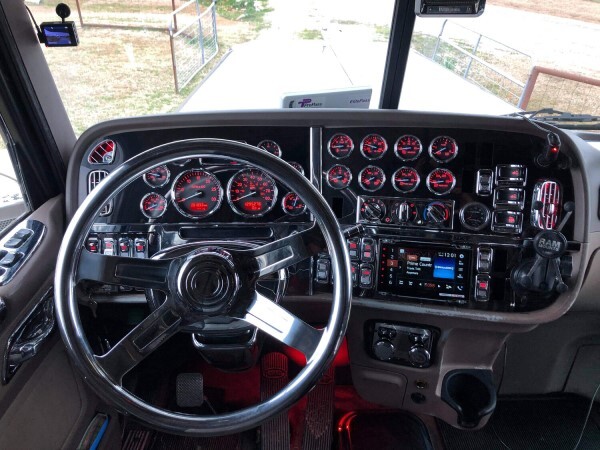
Standard NAMUX3 dash (250K baud rate - traditional round smart gauges behind the steering wheel) |
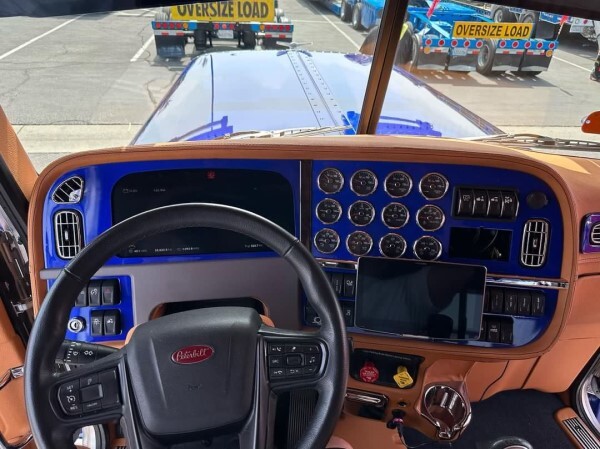
500K baud rate variation (Peterbilt 389 digital display behind the steering wheel) |
Conversion Considerations: Identifying that the truck has DEF and a Chassis Node confirms NAMUX3 electronics. In the 389 model confirm 250K or 500K J1939 speeds for trucks 2022 or newer.
Real World Situation: Regardless if your truck started with a Cummins or Paccar engine, the same Peterbilt NAMUX3 CAT 70-Pin Engine to Cab Harness can be used with ADEM2000-ADEM3 ECM electronics. The same can be said for a Kenworth NAMUX3 CAT 70-Pin Engine to Cab Harness.
NAMUX4: Advanced Integration Evolution (2013–Present)
NAMUX4 is PACCAR's latest and most sophisticated chassis electronics platform, primarily found on modern aerodynamic and vocational models. Unlike earlier generations, NAMUX4 evolved through (3) different controller phases before finally standardizing the current VECU.
NAMUX4 cab controller variations:
- Early NAMUX4 (approx. 2013–2016/2017): Retained a CECU3 (enhanced CECU) with 250K baud rate.
- Mid-transition (approx. 2017–2018/2019): Hybrid CECU3-500 setup running at 500K baud rate.
- Current NAMUX4 (2019–Present): Complete shift to a single VECU (Vehicle Electronic Control Unit) running at 500K baud rate.
The VECU serves as the central brain, consolidating cab, chassis, and engine functions into one powerful module for maximum efficiency and future-proofing.
Key NAMUX4 Models:
- Peterbilt: 567, 579 & 589
- Kenworth: T680, T880 & W990
Engine-to-Cab Interface Nuances:
- Factory engines: PACCAR MX-series and Cummins, with full DEF/SCR integration.
- Firewall connections highly standardized—the controller (CECU3 or VECU) acts as a smart gateway, routing public and private J1939 messages between the engine ECM and cab systems.
- All functions are fully digital: Gauges, multiplexed switches, advanced driver assists, predictive controls, and telematics operate over the J1939 network.
- Baud Rate AGAIN: Baud rate is the speed at which data is transmitted across the CAN bus network (measured in kilobits per second). Early NAMUX4 CECU3 trucks run at 250K baud rate. Starting with the CECU3-500 hybrid and continuing through full VECU trucks, the system operates at 500K baud rate—twice as fast, allowing richer data flow for modern displays, safety features, and tighter integration. PACCAR integrated the engine interface directly into the 500K network, meaning the engine ECM communicates natively at 500K in these later trucks (no separate slower engine bus).
- Power distribution is managed through intelligent load centers with controller oversight.
Conversion Considerations: Pinpointing the exact NAMUX4 variant (CECU3 250K, CECU3-500, or full VECU 500K) clarifies baud rate and controller type— a 250K dash takes a completely different engine to cab harnesses than the same truck with a 500K dash.
Real World Situation: When you replace the engine in a NAMUX4 truck, replacing the Engine to Cab Harness is a given BUT ... the entire Throttle Pedal Assembly has to be replaced rather than just the TPS. If you are removing a Paccar, don't forget the Power Harness and Ground System Harness needs to be replaced. Finally, since the Paccar engine pulls vehicle speed through the ABS system, a VSS Extension Harness and compatible sensor is required.
Why Identification Matters for Your Build
Let’s face it, trucks are a tool used to conduct business, if the tires are not turning the truck is not generating any revenue. The sooner you get the truck back together and on the road, that truck is once again contributing to the companies bottom line. Since both Peterbilt and Kenworth trucks are easily convertible—a successful swap depends on knowing your NAMUX generation of your chassis and seamlessly interfacing with replacement engine ECM electronics. Quick visuals (switch type, module label, dash style, baud rate cues) tell you exactly how the engine will talk to the cab, what harness you'll need, and what programming steps to take.
At Kustom Truck Parts, we live this every day. Send us your year/make/model of your truck, the S/N of the original engine and the replacement engine—we'll help identify the generation of your cab and provide the correct engine-to-cab solution for your repower.
Ready to Repower Your Truck? Call Now: 1-888-564-8890
Mon–Fri 7AM–4PM PST | Speak with a repower specialist